ERNC 2025 – Esports Research Network Conference
Conference Overview
The Esports Research Network Conference 2025 (ERNC 2025) was held from 12–14 November 2025 as a fully online, global conference. Building on previous editions, ERNC25 brought together researchers, practitioners, and students from around the world through a continuous, live digital format designed to support sustained international exchange.
The conference was structured around a hub-based production model, with four regional hubs operating as research and live-streaming nodes. These hubs were hosted by Slippery Rock University of Pennsylvania and Michigan State University (Americas), Staffordshire University (Europe, Middle East and Africa), and UNSW Sydney (Asia-Pacific). Together, the hubs enabled ERNC25 to follow the sun across time zones and remain continuously live throughout the three-day conference.
Theme and Contributions
ERNC 2025 was organised under the theme “Future Realities: Esports as a Global Lab”, positioning esports as both an object of study and a methodological lens for understanding digital transformation. The conference framed esports as a socio-technical ecosystem through which broader dynamics of digital society can be examined, including labour, governance, education, culture, health, and technological change.
Contributions explored esports as a site of experimentation for new forms of work, learning, and participation. Research addressed topics such as digital labour and platform economies, streaming and fan cultures, governance and regulation, intellectual property, and publisher strategies. Several sessions examined how esports reflects wider transformations in digital capitalism, including precarity, professionalisation, and global platform dependence.
Education and learning formed a prominent strand of the programme. Presentations investigated esports-based pedagogies, collegiate and amateur esports development, game-based learning, and institutional integration of esports within educational systems. These contributions highlighted how esports can function as a practical testing ground for innovative educational models in digitally mediated environments.
Health, wellbeing, and performance science represented another key area of focus. Research addressed coaching practices, performance analytics, stress and coping, physical activity, injury prevention, and holistic player development. Together, these contributions reinforced the importance of people-centred approaches to sustainability within esports ecosystems.
The programme also foregrounded issues of diversity, equity, inclusion, and ethics. Contributions examined gender and marginalised participation, moderation and community management, ethical governance, and the social responsibilities of esports organisations. Across these strands, ERNC25 demonstrated how esports research increasingly engages with urgent societal questions while remaining grounded in empirical and applied inquiry.
Format and Participation
ERNC25 featured 110 research presentations, 2 panel sessions, and a dedicated esports showmatch, delivered across three non-stop streaming days. In total, 164 speakers from 33 countries contributed to the programme, reflecting the global reach and interdisciplinary character of the Esports Research Network.
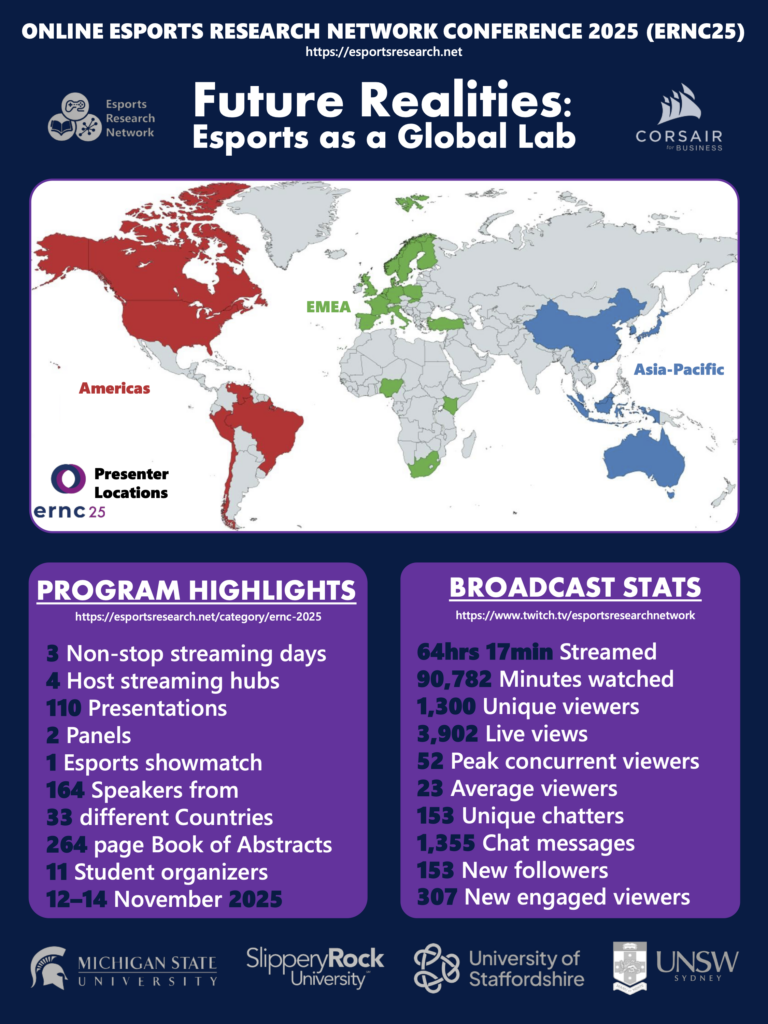
The conference placed strong emphasis on interaction and accessibility. Live discussions, moderated sessions, and chat-based engagement supported continuous exchange between presenters and audiences, while 11 student organisers contributed to production support, moderation, and community facilitation throughout the event.
Production and Support
The conference was supported by Corsair for Business, with Elgato technology enabling consistent, high-quality livestream production across all regional hubs. This support allowed each hub to operate autonomously while maintaining a shared production standard across the global conference.
Media and Documentation
All sessions of ERNC25 were streamed live and recorded, ensuring continued access to presentations and discussions beyond the conference dates.
Conference Chair
Seth E. Jenny
Slippery Rock University of Pennsylvania, United States
Organising Committee
Americas
Seth E. Jenny (Slippery Rock University of Pennsylvania, USA); Amanda C. Cote (Michigan State University, USA); Jonathon “Jono” Eaton (Michigan State University, USA).
Europe, Middle East and Africa (EMEA)
Cameron Vanloo (Staffordshire University, United Kingdom).
Asia-Pacific
Oskar Page (UNSW Sydney, Australia); Guy Lobwein (UNSW Sydney, Australia); Xander Gonzaga (UNSW Sydney, Australia).
Conference Coordination
Tobias M. Scholz (University of Agder, Norway); David Eitel (Acer, Germany).
Scientific Committee
Nicolas Besombes (University of Paris, France); Tom Brock (Manchester Metropolitan University, United Kingdom); Amanda C. Cote (Michigan State University, United States); Joanne Donoghue (New York Institute of Technology, United States); Julia Hiltscher (Birkenstock, Germany); Matt Knutson (University of North Dakota, United States); Seth E. Jenny (Slippery Rock University of Pennsylvania, United States); Yaewon Jin (Ewha Womans University, South Korea); Oliver Leis (University of Leipzig, Germany); Guy Lobwein (UNSW Sydney, Australia); Brian McCauley (Jönköping University, Sweden); Tobias M. Scholz (University of Agder, Norway); Cameron Vanloo (Staffordshire University, United Kingdom).